At the close of the first Christian century, the Apostle John, exiled on the island of Patmos, receives an extraordinary vision. The risen Christ appears to him and dictates seven letters addressed to specific communities in the Roman province of Asia – in the territory of modern-day Turkey. These letters, recorded in chapters 2 and 3 of Revelation, are not mere historical documents. They contain spiritual diagnoses of astonishing precision, valid across the centuries. I have visited each of these sites, studied their layers of history and theology, and every time I have come away with the same conviction: these messages speak to us too, today.
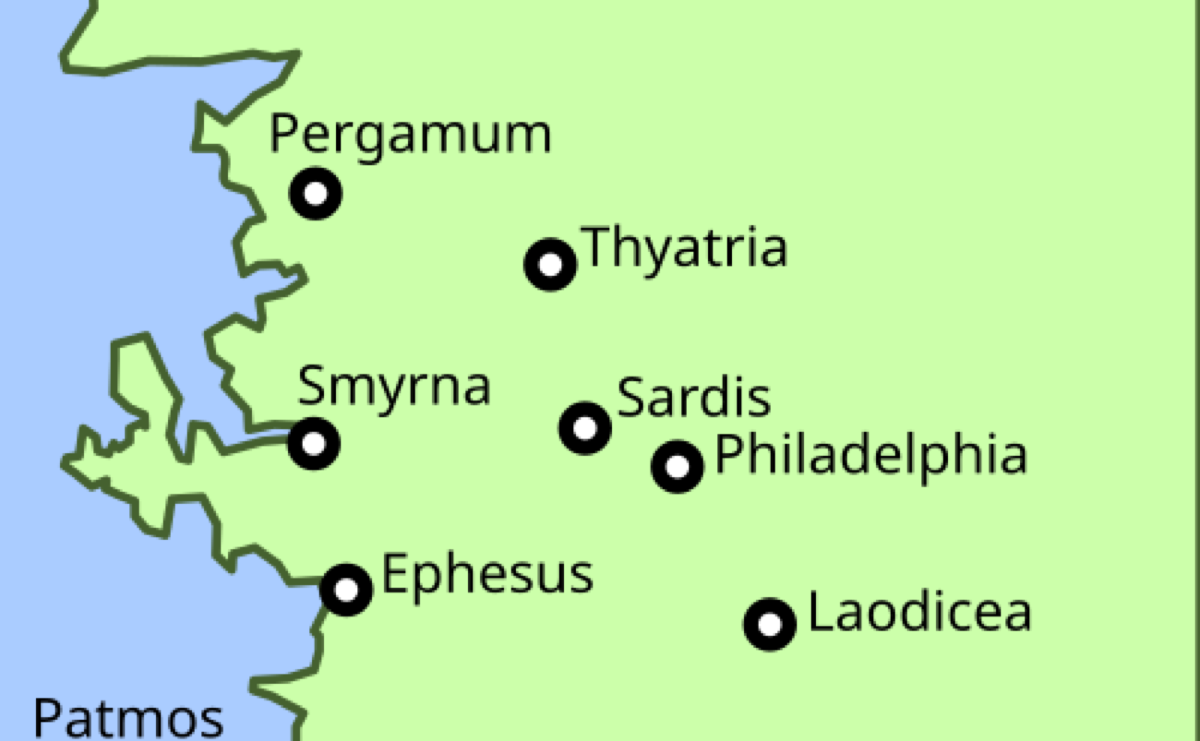
The seven churches form a natural circuit, a route that a first-century messenger would have traveled along the Roman roads, starting from the port of Ephesus and heading north, then southeast. This is no coincidence. The order of the letters follows the geography, and the geography carries theology. Each city had a distinct profile – economic, religious, cultural – and Christ tailors His message to the concrete reality of each community. This is precisely why these letters remain a model of pastoral communication in which the universal meets the particular.
1 Ephesus – The Church That Lost Its First Love
The biblical message
“I know your works, your toil and your patient endurance […] But I have this against you, that you have abandoned the love you had at first. Remember therefore from where you have fallen; repent, and do the works you did at first.”
– Revelation 2:2-5
Ephesus was the metropolis of Roman Asia, a city of over 250,000 inhabitants, renowned for the Temple of Artemis – one of the Seven Wonders of the Ancient World. The Christian community here had an impressive pedigree: founded by the Apostle Paul, strengthened by Timothy, and likely pastored by the Apostle John himself. It was a doctrinally sound, persevering church, vigilant against false teachers. And yet, Christ identifies a fundamental problem: they had lost their primary motivation. Orthodoxy without love becomes spiritual bureaucracy.
What you can see at Ephesus today
The archaeological site at Ephesus is one of the best-preserved in the entire Mediterranean basin. Curetes Street, the Library of Celsus, the great theater with a capacity of 25,000 – all give you a vivid picture of the city’s grandeur. When you walk on the Roman paving stones and see the inscriptions, you understand why the Christian community here was tempted to become an institutional organism: efficient but cold. The city was about performance, about visible excellence. It was easy for faith, too, to become an exercise in correctness without warmth.

The spiritual lesson
The message to Ephesus challenges all of us who have accumulated years of faith, theological knowledge, and correct practices. There is a real risk that spiritual maturity itself becomes a shield against vulnerability. Christ does not criticize the Ephesians’ doctrine or their zeal. The problem is that the engine has changed: they do the right things out of inertia, not out of love. The question Ephesus leaves us with is this: do I still feel the joy of my first encounter with God, or have I put the relationship on autopilot?
2 Smyrna – The Church Under the Pressure of Suffering
The biblical message
“I know your tribulation and your poverty – but you are rich […] Do not fear what you are about to suffer […] Be faithful unto death, and I will give you the crown of life.”
– Revelation 2:9-10
Smyrna – modern-day Izmir – was a prosperous port, a rival of Ephesus, known for its fierce loyalty to Rome. The Christians here receive no rebuke from Christ. They are the only ones, along with Philadelphia, who receive nothing but praise. But their message is far from comfortable: they are told that suffering will continue, and that they must remain faithful within it, not despite it. Bishop Polycarp, a disciple of the Apostle John, would be martyred right here, in the arena at Smyrna, around AD 155, prophetically confirming the words of this letter.
What you can see at Smyrna today
Unlike Ephesus, Smyrna did not remain an empty archaeological site – it is a living city. Izmir, with nearly five million inhabitants, stretches over the ancient ruins. The Roman Agora, partially excavated in the modern city center, offers a fascinating contrast: Corinthian columns rising between apartment buildings. You can visit the traditional site of Polycarp’s martyrdom on Kadifekale hill. This very contrast – antiquity buried beneath modernity – is itself a parable: the faith of Smyrna did not die, but it has been covered by layers of history, of forgetting, of demographic change.

The spiritual lesson
Smyrna speaks of a theology of suffering that offers no cheap solutions. We are not promised that the pain will be short or easy, but that it will be meaningful. In a culture that idolizes comfort and constantly seeks to avoid hardship, the message to Smyrna is counterintuitive: faithfulness is not demonstrated in the absence of difficulty but in the midst of it. The word “crown” (stephanos) used here does not refer to a royal crown but to the laurel wreath of a victorious athlete – a victory won through effort and endurance.
3 Pergamum – The Church at the Heart of Secular Power
The biblical message
“I know where you dwell, where Satan’s throne is. Yet you hold fast my name, and you did not deny my faith […] But I have a few things against you…”
– Revelation 2:13-14
Pergamum was the cultural and religious capital of the region – the seat of the first temple dedicated to the imperial cult in Asia, a center for the worship of Zeus, Athena, and Asclepius (the god of healing, whose symbol – the serpent – is still found in modern medicine). The expression “Satan’s throne” is not a vague metaphor: it very likely refers to the great Altar of Zeus or to the cultic complex on the acropolis. To be a Christian in Pergamum meant living at the epicenter of institutionalized idolatry.
What you can see at Pergamum today
The ancient site of Pergamum is spectacular. The acropolis, perched on a steep hill over 300 meters high, offers a breathtaking view. The steepest theater in the ancient world – with 80 rows of seats – plunges vertiginously down the mountainside. The foundation of the great Altar of Zeus is still visible, although the altar itself was moved to Berlin in the nineteenth century (Pergamon Museum). Below the acropolis, the Asclepion – the ancient healing center – is well preserved, with its therapeutic tunnels and sacred pools. Everything about this place speaks of power: the power of culture, of religion, of the state.

The spiritual lesson
Pergamum poses an uncomfortable question: how do we live out our faith in an environment that is not merely indifferent but actively hostile to its values? The Christians in Pergamum could not emigrate; they lived there. But they were tempted by compromise – to participate in cultic banquets, to make “small concessions” for social integration. Christ’s message acknowledges the difficulty of their position but does not excuse the compromise. It is a lesson for anyone living in a professional, academic, or cultural environment where the pressure to conform is constant: courage does not mean the absence of fear, but the refusal to negotiate what is essential.
4 Thyatira – The Church with Dangerous Tolerance
The biblical message
“I know your works, your love and faith and service and patient endurance, and that your latter works exceed the first. But I have this against you, that you tolerate that woman Jezebel…”
– Revelation 2:19-20
Thyatira was the smallest of the seven cities but receives the longest letter. It was a center for trades and commerce, renowned for its guilds – dyers of purple, tanners, potters, weavers. Lydia, the first European convert mentioned in Acts 16, was a seller of purple from Thyatira. This community’s problem was a subtle one: they did not reject the faith but mixed it with incompatible practices. “Jezebel” (likely a symbolic name, not a literal one) represented a teacher who promoted syncretism – the blending of faith with the pagan practices of the trade guilds.
What you can see at Thyatira today
Ancient Thyatira lies beneath the modern city of Akhisar. The archaeological remains are modest compared to Ephesus or Pergamum: a column from the old basilica, fragments of a Roman road, a few inscriptions. But this very modesty tells us something important. Thyatira was not a monumental center; it was a city of ordinary people, of craftsmen who had to navigate daily between the demands of their guilds (which included participation in pagan rituals) and their convictions of faith. The site helps us understand that the greatest spiritual challenge does not always come from imposing temples but from everyday pressures.
The spiritual lesson
Thyatira warns us that tolerance, in certain forms, can become a kind of spiritual negligence. Not every form of openness is virtuous. There is a fundamental difference between being hospitable toward people and being indifferent toward ideas. The community in Thyatira was growing in acts of love and service – and yet it tolerated a teaching that undermined its foundation. It is a relevant message in an age when the line between inclusion and a lack of discernment is often blurred. True spiritual maturity means loving people without confusing love with the uncritical approval of any doctrine.
5 Sardis – The Church with an Empty Reputation
The biblical message
“I know your works. You have the reputation of being alive, but you are dead. Wake up, and strengthen what remains and is about to die…”
– Revelation 3:1-2
Sardis – once the legendary capital of King Croesus and the kingdom of Lydia – was synonymous with wealth in the ancient world. The first coins in history were minted here. But the city also had a painful past: it had been conquered twice by surprise, because the garrison considered itself impregnable on its steep cliffs and had stopped keeping watch. Christ uses precisely this historical memory in His message: “Wake up!” – a warning that would have resonated powerfully with anyone familiar with the local history.
What you can see at Sardis today
The ruins at Sardis include one of the largest ancient synagogues ever discovered, an impressive Roman gymnasium and bath complex, and the remains of the Temple of Artemis. The acropolis, on a hill of red sandstone, is visible from a distance but difficult to reach – an involuntary metaphor for a church that looks good from afar but is eroding from within. Something in the atmosphere of the place – perhaps the ruins restored a little too well, perhaps the silence a little too deep – makes you feel exactly what Revelation describes: a place that was once glorious and now lives on memory alone.
The spiritual lesson
Sardis is perhaps the most incisive of the seven letters for contemporary believers. The diagnosis “you have the reputation of being alive, but you are dead” describes a reality that many recognize but few acknowledge: a spiritual life that is all facade. Activity without substance. Attendance at events without inner presence. Sardis teaches us that spiritual reputation is not a reliable indicator – neither for communities nor for individuals. The truth about our spiritual condition is not measured by what others see but by what God knows. And yet, the message is not without hope: “Strengthen what remains” – even in a situation of deep crisis, there is a remnant that can be revitalized.
6 Philadelphia – The Church with an Open Door
The biblical message
“Behold, I have set before you an open door, which no one is able to shut. I know that you have but little power, and yet you have kept my word and have not denied my name.”
– Revelation 3:8
Philadelphia – whose name means “brotherly love” – was a frontier city, founded by the kings of Pergamum as a gateway for Hellenistic culture into the interior of Anatolia. It was a city frequently struck by earthquakes, and its inhabitants lived with constant anxiety. Like Smyrna, the Christian community in Philadelphia receives no rebuke. But what is fascinating is that Christ does not praise their strength but their faithfulness in weakness: “you have but little power.” It is a paradoxical commendation that redefines what spiritual success means.
What you can see at Philadelphia today
Ancient Philadelphia lies beneath the modern city of Alasehir – a small, agricultural town in the Cogamus valley. The visible archaeological remains are few: the foundations of a Byzantine basilica, a few columns, an ancient wall. But this very fact is telling. Philadelphia never had the grandeur of Ephesus or the wealth of Sardis. It was always a modest place. And it is precisely this modest community that receives one of the most beautiful promises: an open door of opportunity that no one can shut. When you stand in the center of Alasehir and look around, you understand that God does not work only through spectacle but also through the faithfulness of the small.
The spiritual lesson
Philadelphia is an antidote to the contemporary obsession with numbers, visibility, and quantifiable impact. This small community, without impressive resources, without renowned leaders, without a glorious past, receives divine confirmation precisely because it remained faithful with what it had. They did not deny, did not yield, did not give up. The open door is not a reward for performance but for humble perseverance. It is a profoundly comforting message for anyone who feels too small, too insignificant, too weak to matter in God’s economy.
7 Laodicea – The Lukewarm Church
The biblical message
“I know your works: you are neither cold nor hot. Would that you were either cold or hot! So, because you are lukewarm, and neither hot nor cold, I will spit you out of my mouth.”
– Revelation 3:15-16
Laodicea was one of the most prosperous cities in Roman Asia – a banking center, a medical hub (famous for an ophthalmic ointment), and a textile center (superior-quality black wool). When a devastating earthquake struck the city in AD 60, the Laodiceans refused Rome’s aid and rebuilt everything with their own funds. This economic self-sufficiency is reflected in their spiritual life: “For you say, I am rich, I have prospered, and I need nothing.” Christ uses the very symbols of the city – gold, white garments, eye salve – to show them their true poverty.
What you can see at Laodicea today
The site at Laodicea, near the city of Denizli, has been intensively excavated in recent years. Two theaters, a stadium, temples, early Christian basilicas, an aqueduct system, and an impressive marketplace have been uncovered. But the most eloquent detail concerns the water. Laodicea had no spring of its own; water arrived through aqueducts from the hot springs of Hierapolis (Pamukkale, a few kilometers away). By the time it reached the city, the hot water had cooled and become… lukewarm. The imagery in Revelation is not an abstract metaphor – it is a hydrological fact that any resident of Laodicea would have recognized immediately.
The spiritual lesson
Laodicea is the final message of the cycle, and perhaps the sharpest. The problem is neither wickedness nor ignorance, but comfortable mediocrity. It is the state in which you have enough of everything – material and spiritual alike – that you no longer feel any urgency, any thirst, any hunger. Laodicea describes the risk of prosperity: when everything is going well, self-assessment becomes self-congratulation, and dependence on God becomes a mere formality. Yet the message closes with one of the most tender images in all of Scripture: “Behold, I stand at the door and knock. If anyone hears my voice and opens the door, I will come in to him.” Christ does not force His way in – He knocks at the door of those who believe they need nothing.
What Do the 7 Churches Tell Us When Read Together?
Read individually, each letter offers a precise diagnosis and a specific lesson. Read together, the seven letters map out a complete landscape of spiritual challenges for every age: the loss of initial fervor, the pressure of suffering, compromise with the dominant culture, syncretism, religious facade, felt limitations, and comfortable mediocrity.
There is no community of faith – and no individual believer – that does not find themselves in at least one of these descriptions. This is precisely why physically visiting these sites carries a power that no reading can fully reproduce. When you stand in the theater at Ephesus and realize that Paul preached in that very place, when you walk on the ancient paving stones of Sardis and feel the weight of an empty name, when you look out over the valley from Alasehir and understand what “little power” means – the biblical text takes on three-dimensionality.
The seven churches are not merely monuments of the past. They are mirrors of the present. And the journey through them – physical or spiritual – is an invitation to honest self-examination, undertaken not with the fear of judgment but with the hope of restoration. Because in every letter, without exception, Christ concludes with a promise for “the one who conquers.” And conquering, in the vocabulary of Revelation, does not mean perfection – it means faithfulness.
