A transformative experience following the biblical narrative of the Exodus. From slavery to freedom, from wilderness to promise, through the lands of Egypt and Jordan.
This is not merely a history lesson; it is a living reminder of God's faithfulness, His delivering power, and His call to faith and obedience.
The Pyramids of Giza
At 4,600 years old, the Pyramids of Giza remain one of humanity's most impressive achievements. The three great pyramids — Khufu (Cheops), Khafre (Chephren), and Menkaure (Mycerinus) — demonstrate pharaonic power in a way that surpasses the imagination. One of the Seven Wonders of the Ancient World, the pyramids remain the only wonder still standing today.
These are the monuments of the same civilization that enslaved the people of Israel for generations. Standing at their base, the scale of the oppression becomes tangible.
"So they put slave masters over them to oppress them with forced labor, and they built Pithom and Rameses as store cities for Pharaoh."
— Exodus 1:11 (NIV)
The Sphinx
With the face of Chephren and the body of a lion, the Sphinx was the guardian of the pharaonic realm — a symbol of the divine power that the pharaohs claimed for themselves. Carved from a single rock, this stone guardian has watched over the Giza Plateau for thousands of years. It is considered one of the largest and oldest monumental sculptures in the world.
Here you better understand why the liberation of Israel required divine intervention — Egypt's power was colossal.
The Grand Egyptian Museum
With an exhibition area of 50,000 sqm and a total of 460,000 sqm, the Grand Egyptian Museum houses the most impressive collection of Egyptian artifacts in the world.
The Tutankhamun Collection
Over 5,000 objects belonging to the young pharaoh: the royal throne, ceremonial jewelry, and the famous golden death mask — an iconic symbol of ancient Egypt. Each object speaks of the wealth and complexity of the civilization that confronted Moses.
Nile Cruise
A 2-hour cruise on the world's most famous river. The Nile has nourished civilizations throughout millennia, serving as the source of life for all of Egypt.
On these waters, Moses floated in a basket as an infant, rescued by Pharaoh's daughter. These same waters were turned to blood in the first plague.
"Then she got a papyrus basket for him and coated it with tar and pitch. Then she placed the child in it and put it among the reeds along the bank of the Nile."
— Exodus 2:3 (NIV)
"This is what the Lord says: By this you will know that I am the Lord: With the staff that is in my hand I will strike the water of the Nile, and it will be changed into blood."
— Exodus 7:17 (NIV)
Alexandria
"The Siren of the Mediterranean" — Egypt's second city, founded by Alexander the Great in 331 BC. Alexandria was a center of ancient culture and learning.
The Library of Alexandria
The most famous library of the ancient world, with 700,000 papyrus scrolls. Here the Septuagint was translated — the Old Testament into Greek — making the Scriptures accessible to the Hellenistic world.
Built in the 3rd century BC by the Ptolemaic dynasty, the Library had the ambition of collecting "all the books in the world" — according to ancient sources, it contained up to 700,000 papyrus scrolls.
The Lighthouse of Alexandria
Standing 124 meters tall, the Lighthouse of Alexandria was one of the 7 Wonders of the Ancient World — a literal and symbolic beacon of civilization.
Construction began in 299 BC under Ptolemy Soter (305-282 BC) and lasted approximately 20 years. Located on the island of Pharos, the lighthouse stood for nearly 1,700 years — the tallest lighthouse ever built.
From slavery to freedom
The Exodus Journey is not merely a geographical crossing — it is the path of every believer: from slavery to freedom, from wilderness to promise, from fear to faith.
Coptic Quarter — Cairo
The heart of Egyptian Christianity, with monuments linking biblical history to the history of the early Church.
Babylon Fortress
The Roman fortress that marked the canal between the Nile and the Red Sea — the first nucleus of the city of Cairo. A strategic point that connected two worlds.
Emperor Trajan (98-117 AD) reopened the canal between the Nile and the Red Sea and enlarged the fortress. Emperor Arcadius (395-408 AD) expanded it further, adding a river port where vessels could anchor. In 335 AD, maritime routes were redirected from Alexandria to Babylon Fortress — which became the first nucleus of today's Cairo.
The Hanging Church (Muallaqah)
The most famous Coptic church in Egypt, literally built "hanging" above the gates of Babylon Fortress. A symbol of faith rising above imperial power.
Dedicated to the Virgin Mary ("Sitt Mariam"), the church is accessible via a staircase of 29 steps — hence its popular name "The Church of the Steps." The main nave remains suspended above a passage of the Roman fortress.
Church of St. Sergius
The oldest church in Cairo (4th century), built on the site where, according to tradition, the Holy Family — Joseph, Mary, and the infant Jesus — took refuge during the flight into Egypt.
Known locally as "Abu Serga" (Saints Sergius and Bacchus), it is dedicated to the two martyrs. Tradition holds that the Holy Family — Joseph, Mary, and the infant Jesus — lived here for approximately 7 months, while Joseph worked on the construction of the fortress.
"When they had gone, an angel of the Lord appeared to Joseph in a dream. 'Get up,' he said, 'take the child and his mother and escape to Egypt. Stay there until I tell you.'"
— Matthew 2:13 (NIV)
Cairo — Sinai: The Bitter Wilderness
Journey through the bitter wilderness — Marah — where the Israelites grumbled because of the bitter waters, and God transformed them into sweet water. Here, in the desert, God gave manna and quail to His people.
"When they came to Marah, they could not drink its water because it was bitter. [...] Then Moses cried out to the Lord, and the Lord showed him a piece of wood. He threw it into the water, and the water became fit to drink."
— Exodus 15:23-25 (NIV)
"That evening quail came and covered the camp, and in the morning there was a layer of dew around the camp. When the dew was gone, thin flakes like frost on the ground appeared on the desert floor."
— Exodus 16:13-14 (NIV)
Mount Sinai
A pre-dawn ascent of the mountain where Moses received the Ten Commandments — the founding moment of the covenant between God and His people. Sunrise from the summit of Sinai is one of the most profound spiritual experiences possible.
"Mount Sinai was covered with smoke, because the Lord descended on it in fire. The smoke billowed up from it like smoke from a furnace, and the whole mountain trembled violently."
— Exodus 19:18 (NIV)
"And God spoke all these words: 'I am the Lord your God, who brought you out of Egypt, out of the land of slavery.'"
— Exodus 20:1-2 (NIV)
St. Catherine's Monastery
The oldest continuously inhabited Christian monastery, built between 548-565 AD by Emperor Justinian. Here you will find the Codex Sinaiticus — one of the oldest complete manuscripts of the New Testament — and the Burning Bush, the place where Moses heard the voice of God.
Besides the Burning Bush and the Codex Sinaiticus, the monastery also houses the Charnel House — an ossuary that reminds the monks of the passing of life and the importance of eternity.
"Moses thought, 'I will go over and see this strange sight — why the bush does not burn up.' When the Lord saw that he had gone over to look, God called to him from within the bush, 'Moses! Moses!' And Moses said, 'Here I am.'"
— Exodus 3:3-4 (NIV)
Aqaba
Jordan's only coastal city, gateway to Wadi Rum and Petra. Aqaba marks the crossing from Egypt into Jordan — from the land of slavery to the land of promise.
Aqaba, Jordan's only coastal city, lies 330 km south of Amman. Together with Wadi Rum and Petra, it forms the "Golden Triangle" of Jordanian tourism — three jewels on a single route. A bus tour of the city provides an introduction to Jordanian culture and history.
Wadi Rum
A vast desert of red sandstone mountains, where the landscape seems to belong to another world. Wadi Rum offers a unique experience: tent accommodation — like Moses, 3,500 years later.
4x4 safari through the desert with spectacular sunsets and sunrises. The silence and immensity of the desert help you understand what the wilderness meant for the people of Israel — a place of testing, but also of encounter with God.
"Remember how the Lord your God led you all the way in the wilderness these forty years, to humble and test you in order to know what was in your heart."
— Deuteronomy 8:2 (NIV)
Bedouin tents under the starlit sky
Spectacular sunsets and sunrises in the desert
4x4 safari through the red sandstone desert
PETRA
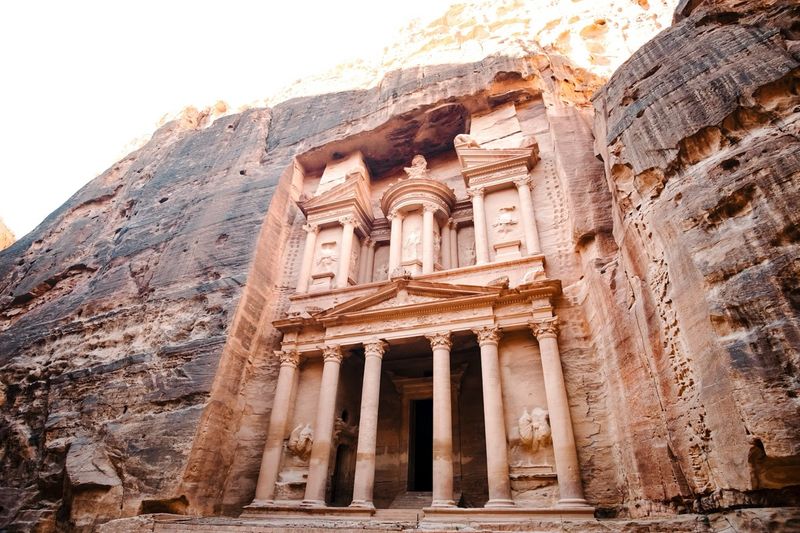
Jordan's greatest national treasure! A UNESCO World Heritage Site with 2,000 years of history and 800 monuments carved into rock. Petra is one of the most astonishing architectural achievements in the history of humanity.
Some archaeologists call it "the Eighth Wonder of the Ancient World." The Treasury (Al-Khazneh) became world-famous after the film "Indiana Jones and the Last Crusade."
As-Siq — the spectacular entrance canyon
Al-Khazneh (The Treasury) — the iconic facade
The Roman Theater — 8,000 seats
The Royal Tombs — carved into rock
Mount Aaron
The burial place of Aaron, the brother of Moses, according to biblical tradition.
"Aaron was gathered to his people and died there on top of the mountain. Then Moses and Eleazar came down from the mountain."
— Numbers 20:28 (NIV)
Petra in the Bible
Petra means "rock" in Greek and is identified as Sela in the biblical text — "the city of rock."
"Amaziah killed ten thousand Edomites in the Valley of Salt and captured Sela in battle."
— 2 Kings 14:7 (NIV)
The Nabataeans
"One of the most talented peoples of the Near East in the time of Jesus." The Nabataeans built Petra as a masterpiece of engineering and art, controlling the trade routes of the ancient world.
King Aretas IV and the New Testament Connection
The reign of the Nabataean king Aretas IV (9 BC — 40 AD) extended as far as Damascus. The Apostle Paul fled Damascus by being lowered in a basket through the wall, precisely because of Aretas.
"In Damascus the governor under King Aretas had the city of the Damascenes guarded in order to arrest me. But I was lowered in a basket from a window in the wall and slipped through his hands."
— 2 Corinthians 11:32-33 (NIV)
Herod Antipas divorced Aretas' daughter in favor of Herodias — the act that led to the condemnation of John the Baptist.
"For Herod himself had given orders to have John arrested, and he had him bound and put in prison. He did this because of Herodias, his brother Philip's wife, whom he had married."
— Mark 6:17 (NIV)
Aretas sent an army that defeated Herod in 36 AD. Jesus Himself called Herod "that fox" (Luke 13:32).
The Edomites and the Roman Conquest
The Edomites, descendants of Esau, inhabited this region before being displaced by the Nabataeans. They migrated to southern Judea, becoming known in the New Testament as the Idumeans (Mark 3:8). Emperor Trajan conquered Petra in 106 AD, transforming the region into the Province of Arabia. The Romans added a theater and a colonnaded street, continuing Nabataean traditions.