In the Footsteps of the Apostle Paul in Greece
Greece is where the Gospel met the Hellenistic world — where the truth of Scripture confronted philosophy, culture, and pagan religion, and where the early churches were born in fire and grace. With Kairos Biblical Trips, you will walk the same roads that the Apostle Paul traveled with unstoppable passion, carrying the message of Christ from the shores of Macedonia to the heart of the Acropolis.
This unique journey combines profound spiritual discovery with the incomparable beauty of the Greek landscapes. From the ancient port of Kavala, where Paul first set foot on European soil, to the ruins of Corinth, where he lived and preached for 18 months — and then, the well-deserved reward: days of rest on the shores of the Ionian or Mediterranean Sea, where body and soul are renewed in the tranquility of the waves.
What Is Included
Airfare
Flight from Romania or Hungary, luggage included
Premium Hotels
Comfortable accommodation throughout the journey, including a seaside resort
Meals Included
Authentic Greek cuisine — breakfast and dinner included
Certified Guide
Professional guide specializing in biblical tourism
Modern Transport
Air-conditioned coach for all transfers and excursions
Seaside Relaxation
At least 2 days of rest at the Ionian or Mediterranean Sea
Kavala (Neapolis) — The Gateway of the Gospel to Europe
This is where it all began. Kavala — known in antiquity as Neapolis — is the port where the Apostle Paul first set foot on European soil, responding to the vision of the Macedonian man calling him: "Come over to Macedonia and help us!" In that moment, the course of history changed forever. The Gospel crossed the continent, and the world was never the same again.
The ancient port, dominated by the Byzantine fortress and the Roman aqueduct, preserves the atmosphere of a place that witnessed the beginning of a spiritual revolution. A stroll along the modern waterfront of Kavala, with views of the Aegean islands, carries you back in time — to the moment when a small ship brought the most important message Europe had ever received.
"During the night Paul had a vision of a man of Macedonia standing and begging him, 'Come over to Macedonia and help us.'" — Acts 16:9 (NIV)
"From Troas we put out to sea and sailed straight for Samothrace, and the next day we went on to Neapolis."
— Acts 16:11 (NIV)
Do not miss the Apostle Paul Monument and the local evangelical churches. Kavala challenges you to ask: what is your "Neapolis" — the place where God is calling you to take the Gospel beyond your comfort zone?
Philippi — The First Church in Europe
Just a few kilometers from Kavala, the ancient ruins of Philippi hold one of the most moving stories in the New Testament. Here, by the riverbank, a woman named Lydia — a dealer in purple cloth from Thyatira — first opened her heart to Paul's words, becoming the first Christian baptized on the European continent. The site of her baptism is still marked today, and the emotion is palpable.
Also at Philippi, Paul and Silas were thrown into prison. But instead of despair, they chose praise. At midnight, their singing shook the prison's foundations in a miraculous earthquake — the doors flew open, the chains fell off, and the jailer, witnessing the power of God, was converted along with his entire household. The ruins of the prison and the Roman forum are living testimonies to these extraordinary events.
"The Lord opened her heart to respond to Paul's message. When she and the members of her household were baptized..." — Acts 16:14-15 (NIV)
"About midnight Paul and Silas were praying and singing hymns to God... Suddenly there was such a violent earthquake that the foundations of the prison were shaken." — Acts 16:25-26 (NIV)
"Believe in the Lord Jesus, and you will be saved — you and your household."
— Acts 16:31 (NIV) — Paul's words to the Philippian jailer
Philip II (father of Alexander the Great) founded this city. Today you can see the Greco-Roman theater, the Byzantine octagonal basilica, and the ancient forum. Paul was accompanied here by Silas, Timothy, and Luke — the physician who recorded everything in the Book of Acts.
"I can do all this through him who gives me strength."
— Philippians 4:13 (NIV) — Written by Paul from prison, specifically for the believers in Philippi
God initiates great works through humble beginnings. The first convert in Europe was a dealer in purple cloth by a riverbank — not in a palace or temple. Authenticity and vulnerability attract genuine conversion.
Thessaloniki — Light in the Darkness
The second-largest city in modern Greece was also a vibrant urban center in antiquity — a city of contrasts, where commerce, culture, and pagan religion intertwined. Here, in the midst of dense religious darkness, the light of the Gospel shone with remarkable intensity. Paul preached in the synagogue for three Sabbaths, and his message took root so powerfully that the faith of the Thessalonians became a model for all of Macedonia and Achaia.
Modern Thessaloniki preserves vestiges of its glorious past — the Arch of Galerius, the Rotunda, and numerous Byzantine churches bearing the imprint of a faith that has survived empires. A walk along the waterfront toward the White Tower provides a perfect setting for reflecting on the perseverance of faith through the ages.
"The Lord's message rang out from you not only in Macedonia and Achaia — your faith in God has become known everywhere." — 1 Thessalonians 1:8 (NIV)
"These men who have caused trouble all over the world have now come here."
— Acts 17:6 (NIV) — The accusation brought against the Christians in Thessaloniki
The city, founded by Philip II and previously named Therma (after the thermal springs), was a vibrant commercial center. Paul preached in the synagogue for three consecutive Sabbaths, converting many God-fearing Greeks and prominent women. Do not miss the Church of Saint Demetrius — a Christian martyr from the 4th century — and the ancient Agora.
"Because our gospel came to you not simply with words but also with power, with the Holy Spirit and deep conviction."
— 1 Thessalonians 1:5 (NIV)
Truth always meets resistance — and this is to be expected, not avoided. Healthy churches are built through the pure Gospel, holy living, and brotherly love.
Meteora — Between Heaven and Earth
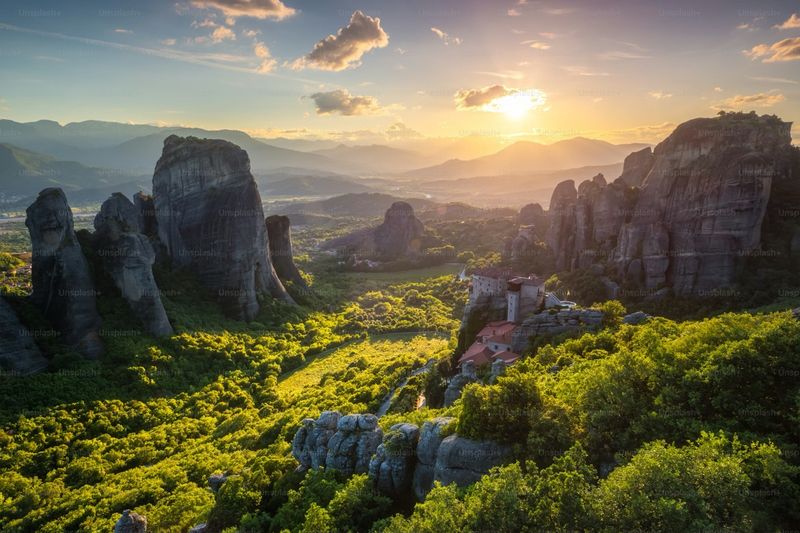
Nothing can prepare you for your first encounter with Meteora. Giant pillars of sandstone, sculpted by time and the elements, rise vertically from the Thessaly plain, and perched on their seemingly inaccessible summits — monasteries centuries old, suspended between heaven and earth. It is a natural and spiritual spectacle that takes your breath away.
Built starting in the 14th century by monks seeking absolute isolation for prayer and contemplation, the monasteries of Meteora are symbols of the soul's ascent toward God — prayers made of stone. The Byzantine frescoes, ancient manuscripts, and overwhelming silence transport you to a dimension of faith that transcends time. It is a place where heaven seems closer, and prayer flows naturally.
"But those who hope in the Lord will renew their strength. They will soar on wings like eagles; they will run and not grow weary, they will walk and not be faint." — Isaiah 40:31 (NIV)
"I lift up my eyes to the mountains — where does my help come from? My help comes from the Lord, the Maker of heaven and earth."
— Psalm 121:1-2 (NIV)
The monastic life at Meteora teaches timeless principles: silence, solitude, regular rhythms of prayer, detachment from worldly distractions, and worship in community. Physical detachment from the world creates the space needed for an encounter with God.
Why Biblical Greece with Kairos?
Biblical Greece is not just an excursion — it is an immersion in the story of how the Gospel spread across our continent. Every place visited, from the port of Kavala to the rocks of the Areopagus, from the suspended monasteries of Meteora to the peaceful beaches of the Greek coast, adds a new layer of understanding and emotion. Come and discover the Greece of Paul — and leave transformed.
Berea — The City of Scripture Searchers
Berea holds a special place in the heart of every Bible lover. When Paul arrived here, fleeing from Thessaloniki due to persecution, he found something unexpected: a city of Scripture study, where the inhabitants had a noble character and examined the sacred texts daily, verifying whether what Paul preached corresponded with Scripture. This spirit of honest and open inquiry made the Bereans a model of knowledge-based faith.
Today, an impressive mosaic of the Apostle Paul marks the traditional site of his preaching in this city. Modern Berea (Veria) is a picturesque town with old quarters, hidden Byzantine churches, and a quiet atmosphere that invites reflection — just as in Paul's time.
"Now the Berean Jews were of more noble character than those in Thessalonica, for they received the message with great eagerness and examined the Scriptures every day to see if what Paul said was true." — Acts 17:11 (NIV)
"Do your best to present yourself to God as one approved, a worker who does not need to be ashamed and who correctly handles the word of truth."
— 2 Timothy 2:15 (NIV)
Visit the Church of Saint Paul, the ancient Jewish quarter, and the Elia River — the site of the apostolic prayer tradition. Not everything preached from the pulpit is necessarily truth — verify it through Scripture! Modern believers must become Bereans: daily searchers of Scripture, not passive consumers of sermons.
"Your word is a lamp for my feet, a light on my path."
— Psalm 119:105 (NIV)
Athens — Truth on the Areopagus
Athens — the cradle of democracy, philosophy, and Western art. When Paul entered this city, his heart was deeply troubled seeing it full of idols. But instead of retreating, he chose confrontation — not with weapons, but with truth. On the hill of the Areopagus, before the Stoic and Epicurean philosophers, Paul delivered one of the most famous speeches in the history of Christianity.
Looking at the Acropolis and the Parthenon from the rock of the Areopagus, you can almost hear the words that shook Athens: "The God who made the world and everything in it is the Lord of heaven and earth and does not live in temples built by human hands." That moment — when revealed truth confronted the most refined human thought — still reverberates in the air of Athens today.
The visit includes the Acropolis with the Parthenon, the Ancient Agora where Socrates and Plato philosophized, and of course, the hill of the Areopagus — the exact site of Paul's speech about the "unknown God."
"People of Athens! I see that in every way you are very religious. For as I walked around and looked carefully at your objects of worship, I even found an altar with this inscription: to an unknown god. So you are ignorant of the very thing you worship — and this is what I am going to proclaim to you." — Acts 17:22-23 (NIV)
Stand where Paul stood. Look at the Areopagus through his eyes. And let the Holy Spirit ignite in you a passion for a rational, living, and courageous faith — a faith that does not fear questions, but meets them with the truth of the Gospel.
Corinth — Grace in the Midst of Chaos
Ancient Corinth was famous — and infamous — throughout the Roman world. A city of commerce, wealth, and immorality, strategically situated on the isthmus connecting the Peloponnese to mainland Greece. The Temple of Aphrodite dominated the city, and the expression "to live like a Corinthian" was synonymous with debauchery. And yet, this is precisely where Paul chose to stay for 18 months — longer than in any other city — transforming this challenging mission field into a vibrant community of faith.
The ruins of ancient Corinth are impressive: the Temple of Apollo with its Doric columns, the agora where Paul was brought before the proconsul Gallio, and the bema — the judgment platform mentioned in the Book of Acts. Here, Paul worked as a tentmaker alongside Aquila and Priscilla, and here he wrote some of the most profound passages in his epistles.
From Corinth, the view extends to Acrocorinth — the fortress that dominates the horizon — and to the Gulf of Corinth, on whose waters trade and ideas flowed between East and West. A place where the contrast between human decadence and the transforming power of grace is more visible than anywhere else.
"For I resolved to know nothing while I was with you except Jesus Christ and him crucified." — 1 Corinthians 2:2 (NIV)
"Do not be afraid; keep on speaking, do not be silent. For I am with you, and no one is going to attack and harm you, because I have many people in this city." — Acts 18:9-10 (NIV)
Try reading the Epistle of 1 Corinthians right on the ruins of ancient Corinth — it is a transformative experience. Paul addressed crucial themes here: sexual ethics, food sacrificed to idols, spiritual gifts, love (chapter 13), and the resurrection of the dead (chapter 15). Each theme takes on new depth when you read it in the place where it was written.
Relaxation — Rest by the Mediterranean Sea
After intense days of spiritual and cultural discovery, the Kairos itinerary includes at least 2 days of relaxation at the Ionian or Mediterranean Sea — because even God rested on the seventh day, and the soul needs time to absorb, meditate, and recharge.
The Greek beaches, with fine sand and crystal-clear turquoise waters, provide the perfect setting for meditation, personal prayer, or simply the pure joy of rest. Sunsets over the Ionian Sea, dinners at tavernas with fresh fish and olives, morning walks along the shore — all contribute to an experience of complete renewal of body, mind, and soul.
This is not just a beach holiday — it is a natural complement to the spiritual journey, a time of quiet in which the lessons learned on Paul's roads can take deep root in your heart.
"Come to me, all you who are weary and burdened, and I will give you rest." — Matthew 11:28 (NIV)
What You Will Gain from This Journey
Connecting with the Bible in 3D
Texts from Acts and Paul's epistles come alive when you walk on the places where they were lived
Strengthening Your Faith
The direct experience of biblical sites strengthens faith through tangible evidence and deep emotions
Drawing Closer to Your Calling
Walking in Paul's footsteps, you will rediscover your own spiritual calling with newfound clarity
Complete Renewal
The seaside relaxation days ensure the physical, mental, and spiritual recharge you need