Discover the Holy Land
Israel is the place where the Bible comes alive. Here, every hill, every valley, every ancient road bears the imprint of events that changed the course of human history. With Kairos Biblical Trips, you will walk the same roads that Jesus walked, sail on the same waters of the Sea of Galilee, and stand in silence at the Western Wall — where the prayers of millions of believers have echoed throughout the millennia.
This premium 7–8 day journey takes you from north to south through the entire Holy Land, combining spiritual discovery with modern comfort and the guidance of a certified, Romanian-speaking theologian guide, alongside licensed local guides.

What's Included
Airfare
Flight from Romania or Hungary, with luggage included
Premium 4★ Hotels
Accommodation in Netanya, Tiberias, Bethlehem, Jerusalem and Ein Bokek
Buffet Meals
Generous buffet at every included meal
Certified Guide
Professional Romanian-speaking guide with experience in biblical tourism
Modern Coach
Transport by modern coach equipped with air conditioning
Audio Headsets
Personal audio system so you can hear every explanation clearly
Northern Israel
Caesarea Philippi (Banias)
The northernmost place where Jesus walked. Here, at the foot of Mount Hermon, where the springs of the Jordan burst from rock, Peter made his confession: “You are the Christ, the Son of the living God”. The ruins of the temple dedicated to Pan and Herod Philip's palace offer a powerful contrast between the pagan world and the message of the Gospel.

“And I tell you that you are Peter, and on this rock I will build My church, and the gates of Hades will not overcome it.”— Matthew 16:18
Mount Hermon and the Springs of the Jordan
With its snow-capped peak, Mount Hermon rises to over 2,800 meters — the highest point in Israel. Identified by tradition as the site of the Transfiguration, this majestic mountain is also the main source of the Jordan River. The springs bursting from the limestone rock create a landscape of breathtaking beauty.
Talmudic Village of Katzrin
A fascinating archaeological site that reconstructs daily life in a Jewish village from the Talmudic period (4th–7th centuries). The restored synagogue and reconstructed houses offer a unique window into the life of communities that preserved and transmitted the sacred texts.
Central Israel and Galilee

Mount Carmel and Haifa
The legendary site of the confrontation between the prophet Elijah and the prophets of Baal. From this mountain, the view encompasses the entire Jezreel Valley — the battlefield of history. At its base, the modern city of Haifa offers a spectacular panorama of the Mediterranean Sea.
“How long will you waver between two opinions? If the LORD is God, follow Him; but if Baal is God, follow him.”— 1 Kings 18:21
Caesarea Maritima
The Roman capital of the province of Judea, built by Herod the Great in honor of Emperor Augustus. Here you will see the spectacular Roman amphitheater, where performances are still held today, the ancient aqueduct that brought water from Mount Carmel, and the ruins of the palace where the apostle Paul was tried before Governor Felix.

“After some days King Agrippa and Bernice arrived at Caesarea to pay their respects to Festus.”— Acts 25:13
Cana of Galilee
The village where Jesus performed His first miracle — turning water into wine at a wedding. This humble place in Galilee reminds us that the first signs of divine glory were revealed in the context of a celebration of life and community.
Nazareth
The hometown of Jesus, where He grew up in Joseph's carpentry workshop. The Basilica of the Annunciation marks the traditional site where the angel Gabriel brought Mary the news of the Savior's birth. The reconstructed village of Nazareth offers a living experience of first-century life.
Sea of Galilee and Cruise
A cruise on the waters of the Sea of Galilee (Lake Tiberias) is one of the most moving experiences of the journey. On these waters, Jesus walked, calmed the storm, and called the fishermen who would become apostles. The lake, surrounded by green hills, preserves the same profound tranquility as two millennia ago.
“He got up, rebuked the wind and said to the waves: 'Quiet! Be still!' Then the wind died down and it was completely calm.”— Mark 4:39
Capernaum
The center of Jesus' Galilean ministry, where He preached in the synagogue and performed numerous miracles. The ruins of the 4th-century synagogue, built over the foundations of the first-century one, and the remains of the Apostle Peter's house are impressive testimonies of the life of the early Christian community.

Mount of Beatitudes
The traditional site of the Sermon on the Mount, where Jesus delivered the Beatitudes. The gentle hillside, with its panoramic view of the Sea of Galilee, creates a setting for meditation and reflection. Here, the words “Blessed are the poor in spirit” take on a very special resonance.

“Blessed are the peacemakers, for they will be called children of God.”— Matthew 5:9
Tabgha
The traditional site of the multiplication of loaves and fishes, where Jesus fed over 5,000 people with five loaves and two fish. The church at Tabgha houses the famous Byzantine mosaic depicting the basket of bread and the fish — one of the most well-known images of early Christianity.
Jordan River — Baptismal Site
At the Yardenit baptismal site, the Jordan flows peacefully among eucalyptus trees and oleanders. Here, where tradition places the baptism of Jesus by John the Baptist, pilgrims from around the world come to renew their covenants of faith. A moment of profound spiritual significance.

“As soon as Jesus was baptized, He went up out of the water. At that moment heaven was opened, and He saw the Spirit of God descending like a dove and alighting on Him.”— Matthew 3:16
Why Israel with Kairos?
Israel is not just a destination — it is an experience that changes the way you read the Bible. Every place visited adds a layer of understanding to the sacred texts. With Kairos, you benefit from a carefully designed itinerary, exceptional guidance in Romanian, and premium conditions, so you can focus on what truly matters: a personal encounter with the living history of faith.
Judean Desert and the Dead Sea

Jericho and the Mount of Temptation
The oldest continuously inhabited city in the world, with over 10,000 years of history. Biblical Jericho is the place where the walls fell at the sound of Joshua's trumpets. The Mount of Temptation (Quarantania), where tradition says Jesus fasted for 40 days, rises steeply above the city — an unforgettable sight.

“Jesus, full of the Holy Spirit, left the Jordan and was led by the Spirit into the wilderness, where for forty days He was tempted by the devil.”— Luke 4:1-2
Ein Gedi National Park
A spectacular oasis in the heart of the Judean Desert, with waterfalls and freshwater springs. Here David hid from King Saul, in the caves above the waterfall. The tropical vegetation in the middle of the desert creates a dramatic contrast — a vivid image of the rest that God offers in the midst of the wilderness.

Masada Fortress
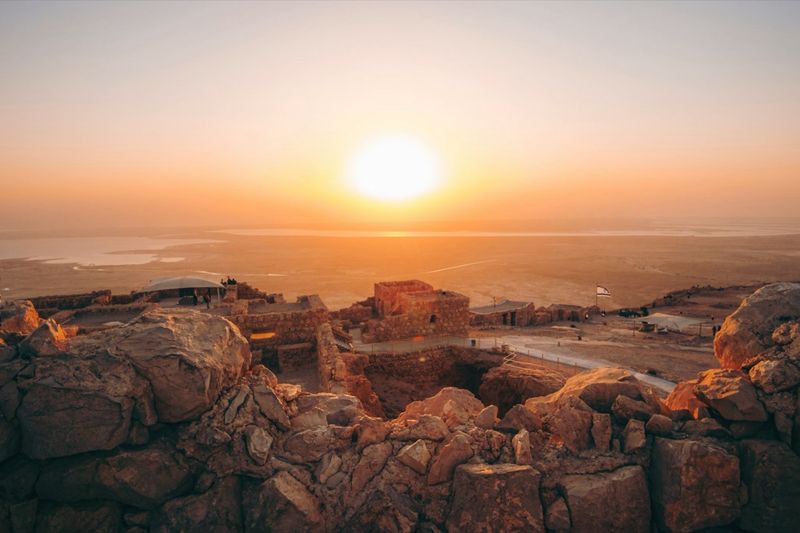
The fortress built by Herod the Great on an isolated plateau above the Dead Sea, a symbol of Jewish resistance. The cable car ascent reveals palaces, Roman baths, the synagogue and storerooms that sustained the last stand of the Zealots against Rome in 73 AD. The view from 400 meters above the Dead Sea is one of the most impressive in Israel.

Ein Bokek — Dead Sea
Located at 430 meters below sea level — the lowest point on Earth — the Dead Sea is a unique experience. The mineral concentration makes sinking impossible, and the therapeutic mud is renowned worldwide. The Ein Bokek resort offers well-maintained beaches and modern comfort on the shores of this biblical sea.


Jerusalem — The Holy City

Jerusalem is the spiritual heart of the world — holy to the three great monotheistic religions. Every street in the Old City, every carved stone, bears the weight of thousands of years of prayer, conflict, and hope. Here, biblical history reaches its apex.
Western Wall (Kotel)
The holiest place of prayer for Jews — the only remnant of the Second Temple, destroyed by the Romans in 70 AD. The massive stones of the retaining wall, placed by Herod the Great over 2,000 years ago, vibrate with the prayers and tears of endless generations. A place of overwhelming spiritual intensity.

“If I forget you, Jerusalem, may my right hand forget its skill.”— Psalm 137:5
Israel Museum — Dead Sea Scrolls
Housed in the iconic Shrine of the Book, the museum holds the oldest known biblical manuscripts — over 800 texts discovered in the caves of Qumran between 1947 and 1956. Among them, the complete scroll of the prophet Isaiah, dated over 2,000 years ago, confirms the remarkable fidelity of biblical text transmission throughout the millennia.

Cardo — Old City
The central boulevard of ancient Jerusalem, rebuilt during the Byzantine period, with massive columns and shops that evoke imperial splendor. Today, the Cardo combines original ruins with art galleries and shops, offering a walk through layers of history.
The Garden Tomb
A place of silence and meditation, considered by many to be the site of the crucifixion and burial of Jesus. The garden, with its ancient cistern, rock-hewn tomb and signs of an early Christian place of worship, offers an intimate setting for reflection on the central event of the Christian faith.

“He is not here; He has risen, just as He said. Come and see the place where He lay.”— Matthew 28:6
Mount Scopus and the Mount of Olives
From the Mount of Olives, the panorama of Jerusalem is unforgettable — the Dome of the Rock gleaming in the sun, the Old City spread out at your feet, the Kidron Valley between you and the city walls. Here Jesus wept for Jerusalem and from here He ascended to heaven, according to Christian tradition.

Garden of Gethsemane
At the foot of the Mount of Olives, among ancient olive trees — some dated to over 900 years — the Garden of Gethsemane preserves the memory of the night when Jesus prayed with tears of blood before His arrest. The silence that pervades the garden makes this one of the most moving places on the entire journey.
“Father, if You are willing, take this cup from Me; yet not My will, but Yours be done.”— Luke 22:42

Via Dolorosa
The Way of Suffering — the traditional path that Jesus carried the cross from condemnation to Golgotha. The 14 Stations of the Cross trace the narrow streets of the Old City, each marking a moment of the Passion. A profoundly moving pilgrimage experience.
Church of the Holy Sepulchre
Built in the 4th century by Empress Helena, mother of Constantine the Great, this is the holiest church in Christendom. Under its domes and vaults lie, according to tradition, both the site of the crucifixion (Golgotha) and the empty tomb of Jesus. A place of uninterrupted pilgrimage for nearly 1,700 years.
Church of Saint Anne
A masterpiece of 12th-century Crusader architecture, renowned for its exceptional acoustics — a sound made inside reverberates for several seconds, creating an astonishing sonic effect. Tradition identifies this place as the home of Mary's parents, Joachim and Anne, and the site of her birth.

Pool of Bethesda
The archaeological site near the Church of Saint Anne, where Jesus healed the paralytic who had lain for 38 years. Excavations have revealed the double pools mentioned in the Gospel of John, confirming the accuracy of the biblical account.

“Then Jesus said to him, 'Get up! Pick up your mat and walk.' At once the man was cured; he picked up his mat and walked.”— John 5:8-9