Malta, Sicily, Rome & Vatican

From shipwreck to the triumph of faith — in the footsteps of the Apostle Paul

🇲🇹 🇮🇹 🇻🇦
Spiritual Cultural Apostle Paul Sacred History
Request Updated Offer

A journey of the soul

This is not just a vacation — it is a journey of the soul, an opportunity to walk in the footsteps of the apostles and martyrs who laid the foundations of the Christian faith. From the rocky shores of Malta, where Paul survived a dramatic shipwreck, to the catacombs where the first Christians proclaimed their faith in silence, and all the way to the heart of imperial Rome where the Gospel triumphed over worldly power — every step connects you with the deep roots of our faith.

We invite you to walk through places steeped in sacred history and vibrant testimonies — places where shipwreck became mission, persecution became witness, and the death of martyrs became the seed of the Church. The Book of Acts, chapters 27 and 28, comes alive before your eyes.

"In this way everyone reached land safely."

— Acts 27:44 (NIV)
1

San Pawl Milqi — Malta

Where shipwreck became mission

The journey begins at the archaeological site of San Pawl Milqi in Burmarrad, in northern Malta — the place that marks one of the most dramatic episodes in the life of the Apostle Paul. Here, after 14 days of storm on the Mediterranean Sea and a violent shipwreck, Paul and the 276 souls on board reached shore safely. What seemed like a disaster was transformed into one of the apostle's most fruitful missions.

The islanders, far from being hostile, welcomed the shipwreck survivors with remarkable kindness. The Apostle Paul was warmly received and hosted for three days in the home of Publius, the Roman governor of the island. The ruins of the Roman villa discovered here are identified by tradition with the residence of Publius — the place of hospitality that opened the door for the Gospel on this island.

"There was an estate nearby that belonged to Publius, the chief official of the island. He welcomed us to his home and showed us generous hospitality for three days. His father was sick in bed, suffering from fever and dysentery. Paul went in to see him and, after prayer, placed his hands on him and healed him."

— Acts 28:7-8 (NIV)

Spiritual applications: Be a Publius — practice Christian hospitality without conditions. Pray for the sick with boldness, as Paul did. And above all, never underestimate a shipwreck — what seems accidental from a human perspective may be God's method of planting you in a new place for mission.

"Do not forget to show hospitality to strangers, for by so doing some people have shown hospitality to angels without knowing it."

— Hebrews 13:2 (NIV)
2

Mdina — The Silent City

The spiritual heart of Malta

Mdina, the ancient capital of Malta, rises on a hill with panoramic views over the entire island. Known as "The Silent City" for its almost mystical quietness, Mdina is surrounded by imposing medieval limestone walls that conceal within a labyrinth of narrow streets, noble palaces, and centuries-old churches. Here beats the spiritual heart of Malta — a place where sacred history and architectural beauty intertwine harmoniously.

St. Paul's Cathedral: Built in 1693 in Maltese Baroque style, the cathedral stands on the site where, according to tradition, Governor Publius received the Apostle Paul. The interior is a masterpiece: domes painted with scenes from the apostle's life, polychrome marble mosaics, monumental frescoes, and an altar that radiates solemn grandeur. Every detail speaks of the reverence the Maltese people hold for the apostle who brought them the faith.

The Cathedral Museum: Houses an impressive collection of ancient manuscripts, rare maps, biblical engravings, icons, and Maltese religious art — testimonies of a faith that has traversed centuries of tumultuous history.

"He says, 'Be still, and know that I am God.'"

— Psalm 46:10 (NIV)
Mdina — The Silent City, Malta

Spiritual applications

Seek stillness to hear God (Psalm 46:10). Be open like Publius to the Gospel and to mission (Acts 28:7). Visit with your heart, not just your feet — let your journey be an inner one as well.

3

St. Paul's Grotto — Rabat

The most venerated Pauline site in Malta

Beneath the Church and College of St. Paul in Rabat lies the most venerated Pauline site in Malta — the grotto where, according to tradition, the Apostle Paul lived for three months after the shipwreck. This simple space, carved into rock, was the place from which Paul withdrew for prayer, preaching, and healing, and where he formed the first Maltese believers, including Publius, who would become the first bishop of Malta.

Visiting the original grotto is a profoundly moving experience: the raw simplicity of the rock contrasts with an imposing 18th-century statue of the apostle and ancient inscriptions that bear witness to the uninterrupted veneration of the site. Near the grotto are the Catacombs of St. Agatha, with early Christian frescoes from the 4th century, and the Wignacourt Museum, which complete the picture of a thriving Christian community from the very beginning.

"But we preach Christ crucified: a stumbling block to Jews and foolishness to Gentiles, but to those whom God has called, both Jews and Greeks, Christ the power of God and the wisdom of God."

— 1 Corinthians 1:23-24 (NIV)

In a humble cave, without a podium or amphitheatre, Paul planted the seed of a faith that has endured for nearly two millennia on the Maltese islands. It is a lesson about the power of the Gospel — which does not depend on external circumstances, but on the presence of the Holy Spirit.

Spiritual applications

Find time for silence — Paul withdrew for prayer. Choose a moment of stillness too. Be a simple witness — you do not need cathedrals to proclaim the Gospel. Welcome the stranger with hospitality — just as the Maltese welcomed Paul.

"This grotto is not just a cave, but a spark of the Gospel in a dark world."

— A Maltese Benedictine monk
4

The Catacombs of Rabat

Where faith burned in the darkness

St. Paul's Catacombs: Beneath the town of Rabat stretches a network of underground galleries where the first Maltese Christians were buried and where, during persecutions, they gathered in secret for prayer and the breaking of bread. Long corridors, funerary chambers, and early Christian symbols — the fish, the cross, the dove — speak of a faith lived on the edge between life and death. These catacombs are among the oldest evidence of organized Christianity in the entire Mediterranean basin.

St. Agatha's Catacombs: Shelter early Christian frescoes from the 4th century of surprising beauty — images of faith that have survived in the underground darkness for over 1,600 years. These catacombs were not just burial places, but true gathering spaces for the early Christian church — the place where the community met with Christ despite the threats.

"Every day they continued to meet together in the temple courts. They broke bread in their homes and ate together with glad and sincere hearts."

— Acts 2:46 (NIV)

Descending into the catacombs is an overwhelming experience: in these dark, damp corridors, the first Christians professed their faith at the cost of their lives. The words of Tertullian resonate here with special force: "In the darkness of the catacombs, the light of hope in Christ burned."

In the Footsteps of the Apostle Paul

This journey invites you to see the shipwrecks of your own life through the eyes of faith. What seems like an accident may be providence. What seems like an ending may be a new beginning. Paul's footsteps in Malta, through Sicily, and all the way to Rome are proof that God carries His plan to fulfillment — even through storms, chains, and shipwrecks.

5

Roman Villa — Domus Romana

The luxury of Rome vs. the simplicity of the Gospel

Also in Rabat, we visit the Domus Romana — a museum built on the ruins of a Roman residence dating from the 1st century BC to the 1st century AD, exactly the period when Paul walked on Maltese soil. The original mosaics are spectacular: geometric and figurative scenes of remarkable finesse, household objects, statues, and Latin inscriptions that reconstruct the daily life of the Roman elite in Malta.

The contrast is powerful and intentional: just a few hundred meters away, the Christian catacombs speak of simplicity, humility, and renunciation, while the Roman villa displays the luxury, power, and comfort of the pagan world. This is exactly the tension Paul describes in his epistles — the call to choose between the seen and the unseen, between passing glory and eternal inheritance.

"Do not conform to the pattern of this world, but be transformed by the renewing of your mind. Then you will be able to test and approve what God's will is — his good, pleasing and perfect will."

— Romans 12:2 (NIV)

Spiritual applications

Learn from history — the catacombs and the Roman villa show us the contrast between worldly glory and the humility of faith. Cherish simple faith — the first Christians did not have cathedrals, but caves; not crowns, but the cross. Be a living testimony — just as the believers in Rabat preserved their faith in secret, let us also be lights in dark places.

"The true treasure of a city is not in golden mosaics, but in the prayers of the saints."

— Origen
6

Valletta

Faith anchored in Christ

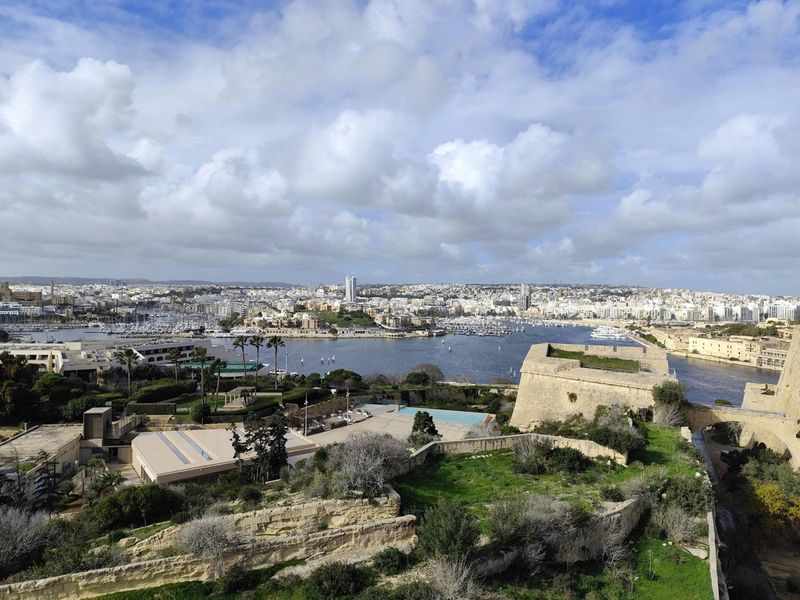
Malta's capital, Valletta, is a fortress city built by the Knights of the Order of St. John — a Christian military order that defended the Maltese islands for centuries. Narrow streets paved with stone, ancient churches on every corner, massive bastions, and golden limestone squares tell the story of a faith anchored in Christ, yet challenged by wars, sieges, and trials.

St. John's Co-Cathedral, with its stunningly rich Baroque interior, houses Caravaggio's masterpiece — "The Beheading of Saint John the Baptist," the only work signed by the artist. The Barrakka Gardens offer a spectacular panorama of the Grand Harbour, and the Grandmaster's Palace bears the mark of centuries of military and spiritual history.

Valletta is living proof that wherever the Gospel arrived, it transformed not just souls, but entire civilizations.

Valletta, Malta

Spiritual applications

Faith is built in the midst of siege — just as Valletta was born from an attack, our souls grow stronger through trials. Christ is our tower of refuge — it is not bastions that protect us, but the presence of God.

"The remnants of the past are the seeds of today's faith."

— Anonymous Maltese
7

Sicily — In Paul's Footsteps toward Rome

After the shipwreck in Malta, Paul and his companions sailed to Syracuse, in Sicily, where they spent three days (Acts 28:12). Syracuse was one of the greatest and wealthiest cities of the ancient world — the homeland of Archimedes and a cultural center of the Mediterranean.

"From there we set sail and arrived at Rhegium. The next day the south wind came up, and on the following day we reached Puteoli."

— Acts 28:13 (NIV)

From Sicily, the route continues along the coast — the exact road Paul traveled 2,000 years ago, from Malta to mainland Italy and, finally, to Rome.

8

Rome — Capital of the Empire

Colosseum, Rome

Rome — the center of the ancient world, the place where Paul arrived in chains but preached freely for two years (Acts 28:30-31). The Eternal City bears the mark of Christianity in every stone.

The Colosseum

The Flavian Amphitheatre, the largest in the world, with a capacity of 50,000-80,000 spectators. Here, thousands of Christians gave their lives for the faith in the early centuries. The supreme symbol of persecution — but also of the triumph of faith.

The Roman Forum

The political, religious, and social center of ancient Rome. The temples, basilicas, and triumphal arches tell the story of an empire that tried to crush Christianity — but which, in the end, was conquered by it.

The Roman Forum

Via Appia — "The Queen of Roads"

The road Paul walked on his way to Rome (Acts 28:15). One of the oldest Roman roads, the Via Appia was the "highway" of antiquity. Here, the brothers from Rome came to meet Paul — and he, "at the sight of these people, thanked God and was encouraged."

"The brothers and sisters there had heard that we were coming, and they traveled as far as the Forum of Appius and the Three Taverns to meet us. At the sight of these people Paul thanked God and was encouraged."

— Acts 28:15 (NIV)

Mamertine Prison — Paul's Prison

The oldest prison in Rome, where tradition holds that both Peter and Paul were imprisoned before their martyrdom. A narrow, damp, dark underground chamber — and yet, the place where two apostles continued to preach the Gospel.

9

Vatican — The Heart of Christendom

St. Peter's Basilica, Vatican

The smallest independent state in the world, yet with the greatest spiritual influence. The Vatican is built on the site where the Apostle Peter was crucified upside down — and where his bones were discovered beneath the altar of the Basilica.

St. Peter's Basilica

The largest church in the world, with the dome designed by Michelangelo. The interior impresses with its grandeur, mosaics, sculptures (including Michelangelo's famous Pieta), and the spiritual depth it conveys. Beneath the altar, a stairway descends to the tomb of the Apostle Peter.

St. Peter's Square

Designed by Bernini, the square with its 284 columns symbolizes the arms of the Church open to the world. A gathering place for millions of believers from every corner of the earth.

Vatican Interior

"And I tell you that you are Peter, and on this rock I will build my church, and the gates of Hades will not overcome it."

— Matthew 16:18 (NIV)

Why this trip is unique

Acts 27-28 come alive

Follow step by step the Apostle Paul's journey from shipwreck to mission — from the storm at sea to the healing of the sick, from the grotto in Rabat to the road to Rome. Scripture becomes a lived experience.

4 countries, one narrative

Malta, Sicily, Rome, and Vatican — each destination is a chapter in the same story: the journey of faith from the periphery of shipwreck to the heart of world power.

2,000 years of unbroken Christianity

From the first Maltese converts to the basilicas of Rome — follow the thread of a faith that was never extinguished, passing through catacombs, persecutions, and imperial triumph.

Biblical and spiritual guidance

Each site is explored from a biblical perspective, with on-site study, moments of prayer, and reflection. Not just what happened here — but what it means for you today.

Quotes that illuminate the path

"Hospitality is a bridge between people and God."

— Dietrich Bonhoeffer

"When God shipwrecks you, He doesn't do it to lose you, but to plant you in a new place for mission."

— John Piper

"Wherever Paul went, a group of people was transformed."

— John Stott

This journey invites you to see the shipwrecks of your own life through the eyes of faith. What seems like an accident may be providence. What seems like an ending may be a new beginning. Paul's footsteps in Malta, through Sicily, and all the way to Rome are proof that God carries His plan to fulfillment — even through storms, chains, and shipwrecks.

Colosseum, Rome
The Roman Forum
St. Peter's Basilica, Vatican

"Offer hospitality to one another without grumbling."

— 1 Peter 4:9 (NIV)

Request an Offer for Malta, Sicily, Rome & Vatican